
Learning to Think Like a Salesforce Architect (Not Just Build Like One)
The jump from building Salesforce solutions to architecting them isn’t about learning new tools. It’s about changing how you think about problems before you ever open Setup.
I once built a Flow that was technically perfect. It handled every edge case, routed approvals correctly, and even sent nicely formatted email alerts. The demo was flawless. Then it hit production, and within a week, users had figured out three different workarounds to avoid it entirely.
That was the moment I started to see the gap between building something in Salesforce and actually architecting a solution. Building is about making things work. Architecting is about making things work for people, at scale, over time. Big difference.
Stop Starting with Objects: The Salesforce Architect Mindset Shift
Most of us learn Salesforce the same way. You get a requirement, and your brain immediately jumps to schema. What objects do we need? What fields go where? Accounts, Contacts, Opportunities -- you start sketching the data model before anyone's finished explaining the problem.
I did this for years. And honestly, it works fine for straightforward builds. But it falls apart when you're designing something that spans multiple teams, processes, or stages of a customer lifecycle.
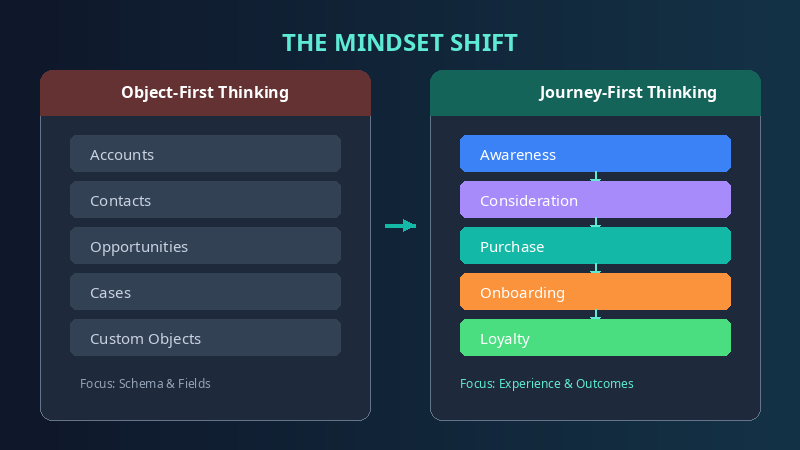
The shift that changed things for me was starting with the journey instead of the schema. Before I think about objects and fields, I ask: what is the user actually trying to accomplish? What does the process look like from the customer's perspective, from first touch to closed deal to ongoing support?
When you map out Awareness to Purchase to Loyalty first, the data model starts to reveal itself naturally. You stop building objects for the sake of it and start building them because they serve a specific step in the process. The schema becomes a consequence of good design, not the starting point.
This sounds obvious when you say it out loud. But I've sat in enough discovery sessions to know that most teams still jump straight to "what custom objects do we need" within the first ten minutes.
Design for the Mess: Real-World Salesforce Architecture
Here's the thing I always come back to: demos lie. Every Salesforce demo runs on clean data, patient users, and integrations that respond instantly. Production has none of that.
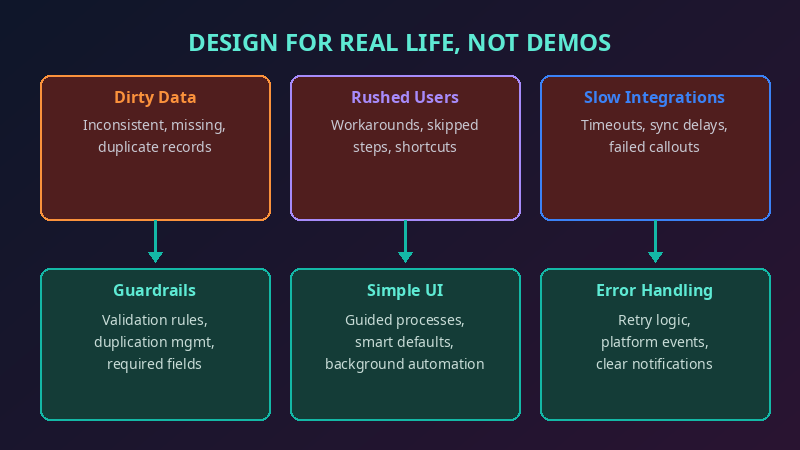
Your data is messy. Half the Account records have no industry filled in. Contacts have duplicate emails. Someone imported a CSV last year with the company name in the phone field. This is not an edge case. This is the baseline.
Your users are impatient. They're not going to read that helpful guidance text you put on the Lightning page. They're going to click the fastest path to closing their task, even if that means skipping three required fields by changing the record type.
And your integrations? Slow. That middleware that worked perfectly in sandbox takes four seconds to respond when the ERP is under load. Now your screen Flow is timing out and users are hitting refresh, creating duplicate records.
I design for all three of these realities from day one. No exceptions.
For dirty data, that means validation rules and duplicate management that actually work -- not just "required fields on the layout" that people bypass with a dash or a period. It means building Flows that check whether the data they need actually exists before trying to use it.
For impatient users, it means shorter forms, smarter defaults, and automation that runs in the background instead of blocking them. If your process has fifteen steps, users will find a shortcut. Better to design a guided path that's genuinely quick than to build a fortress they'll climb over.
For unreliable integrations, it means retry logic, clear error messages, and platform events instead of synchronous callouts where possible. The user shouldn't have to understand why something failed. They should see a clear next step.
Governor Limits and Salesforce Constraints Are the Point
Early on, I used to get frustrated by governor limits. 100 SOQL queries per transaction? 150 DML statements? It felt like Salesforce was getting in the way.
I don't see it that way anymore.
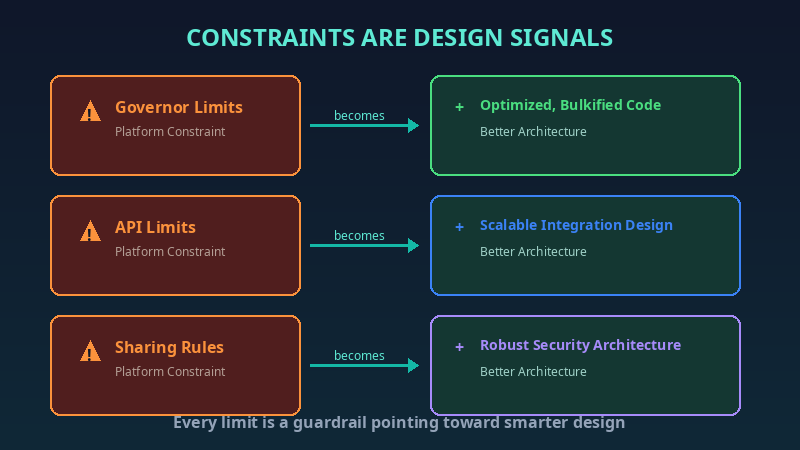
Governor limits forced me to learn bulkification properly. Instead of writing Apex triggers that query inside a loop -- something that works fine with five records and explodes at two hundred -- I had to learn to write code that scales. That's not a limitation. That's a design signal telling you something.
API limits pushed me toward thinking about integration architecture instead of just wiring things together. You start asking better questions: do we really need real-time sync, or would a scheduled batch work? Can we use change data capture instead of polling? Should this be an outbound message or a platform event?
Sharing rules and field-level security forced me to think about data access models properly. Instead of giving everyone System Admin profiles and calling it done, I had to design permission sets, sharing rules, and visibility that actually match how the business works.
Every constraint Salesforce gives you points toward better architecture. The 50,000-row query limit means you should be filtering properly. The CPU time limit means your code should be efficient. These aren't obstacles. They're guardrails.
The architects I respect most aren't the ones who found clever workarounds to avoid limits. They're the ones who designed solutions that never hit them in the first place.
Build Products, Not Just Projects
Look, there's a real difference between building a one-off solution for a single org and building something that could work across multiple orgs or teams. Even if you're only working in one org, thinking like a product builder changes how you design.
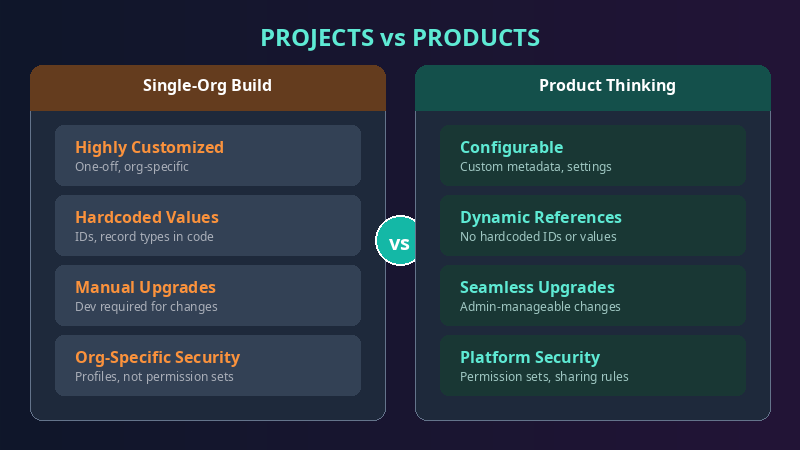
When you build a project, you hardcode. Org-specific IDs in your Apex classes. Record type names baked into Flow decisions. Custom metadata that only makes sense in this particular sandbox. It works, but it's fragile. Every change requires a developer.
When you think like a product builder, you make things configurable. Custom metadata types instead of hardcoded values. Custom settings that admins can update without touching code. Flows that reference dynamic inputs instead of static IDs.
I'm not saying every internal build needs to be a managed package. That would be overkill. But the mindset shift matters. Ask yourself: if I had to deploy this to a second org tomorrow, how much would break? If the answer is "everything," you've built something that's going to be painful to maintain even in the org it was designed for.
The practical version is simple. Use custom metadata types for values that might change. Write Apex that doesn't assume specific record types or picklist values exist. Build Flows with input variables instead of hardcoded references. This isn't extra work. It's the kind of work that saves you from a nightmare six months from now.
What This Actually Looks Like Day to Day
If I had to distill the architect mindset into a short list of habits, it would be this.
Start with users. Before you build anything, know who's going to use it, what they're trying to do, and what their day actually looks like. Not what their manager says their day looks like -- what they actually do. Talk to them. Watch them work. The gap between the requirements doc and reality will surprise you.
Design for scale and longevity. Whatever you're building today, assume the data volume will triple and the team will double. If your solution can't handle that, you're building technical debt, not a feature.
Master the platform fundamentals. Understand governor limits, the data model, sharing and security, and the order of execution. These aren't advanced topics. They're the foundation. You can't architect around constraints you don't understand.
Build for your future self. Six months from now, you -- or someone else -- will need to modify what you built. Will they understand it? Is there documentation? Are the Flows named clearly? Is the Apex readable? If maintaining your own work feels painful, that's a sign.
The jump from builder to architect isn't about certifications or titles. It's about the questions you ask before you start building. Get those right, and the technical execution follows.
If you're working on a Salesforce project and want an architect's perspective -- or if your current setup is getting hard to maintain -- I'd be happy to talk it through. Check out my services or get in touch directly.